 |
15 September 2026
|
15 September 2026
A product can look great on a drawing and work as intended as a prototype, but that doesn’t necessarily mean it will be straightforward to manufacture at scale. Components may be hard to source, a PCB layout might complicate automated assembly, or awkward manual assembly stages could slow production.
Design for Manufacturing (DfM) and Design for Assembly (DfA) are two approaches that help identify and address these challenges before full production begins. Although closely related, they focus on different areas of production. We break down the differences between DfM and DfA and why they are both important in electronics manufacturing services.
Design for Manufacturing (DfM), sometimes called Design for Manufacturability, is a way to design a product with the manufacturing process in mind throughout. It focuses on ensuring that a product can be manufactured reliably, repeatedly, and efficiently at scale.
Consider manufacturing a PCB, for example. The board works as expected, but certain design decisions make it more difficult to manufacture than necessary. This could be from poor component placement, pad layout, or even a scarcity of the individual components required. Even if the board functions exactly how it should, these factors can make products more difficult to manufacture consistently and efficiently.
DfM is flexible by design and can cover many areas depending on the product and its manufacturing requirements. For PCB and electronics manufacturing, some common areas include:
DfM can also involve checking whether a PCB follows established design rules to help engineers implement design guidelines for spacing, pad geometry, component placement, and other manufacturing requirements.
Applying DfM helps ensure that designs align with available equipment, materials, and manufacturing operations. Say, it could mean replacing a hard-to-source component with a more readily available alternative to reduce supply risk. Ultimately, DfM bridges the gap between a design that works and one that supports product reliability and cost-effective production.
Design for Assembly (DfA) is a process that considers what happens when the individual parts of an assembly come together. It applies practical assembly principles to simplify how components are brought together and make the finished product easier to assemble consistently.
Say an electronic product is designed with several different types and sizes of screws. The design works in practice and can be manufactured, but the different screws mean extra picking, handling, and assembly. DfA review would identify this as an opportunity to standardise the screws or reduce how many go into the final product.
Like DfM, DfA can cover different areas depending on the product and assembly process. For electronics manufacturing, some common areas include:
With these steps simplified, DfA can reduce assembly time, lead to fewer errors, and make production more consistent, all while helping to reduce manufacturing costs. Designing with fewer components can also reduce handling and simplify the overall assembly process.
DfM and DfA are most effective when introduced early in the design phase and carried through as the product moves towards production. A 2026 study in Production Engineering outlined that decisions made during the earliest design stages can account for up to 70% of a product’s total manufacturing cost.
Early integration of DfM and DfA can guide choices around components, PCB layout, materials, testing, and assembly methods. As prototypes are built and production requirements become clearer, the design can be refined towards an optimal design for manufacturing and assembly before full-scale production begins. Key stages where DfM and DfA can add value include:
It’s worth noting that DfM and DfA are not always one-off product reviews. They can continue to add value throughout the product lifecycle as new information leads to further design changes. Prototyping may identify an awkward assembly step, testing can highlight poor access to a component, or changes in component availability could make an alternative part more suitable.
DfM and DfA work towards the same overall goal: making a product easier to produce successfully. The difference lies in their focus, with DfM on manufacturability and DfA on assembly efficiency.
DfM looks at how individual parts are designed and manufactured. It considers factors such as material choice, tolerances, production processes, tooling, and part complexity to make each component easier and more cost-effective to produce.
DfA takes the next step by considering how those components come together. It focuses on reducing the number of parts, simplifying joining methods, improving accessibility, and making assembly faster and less prone to error.
In simple terms, DfM asks How can we make this part more efficiently?, while DfA asks How can we put the finished product together more efficiently?
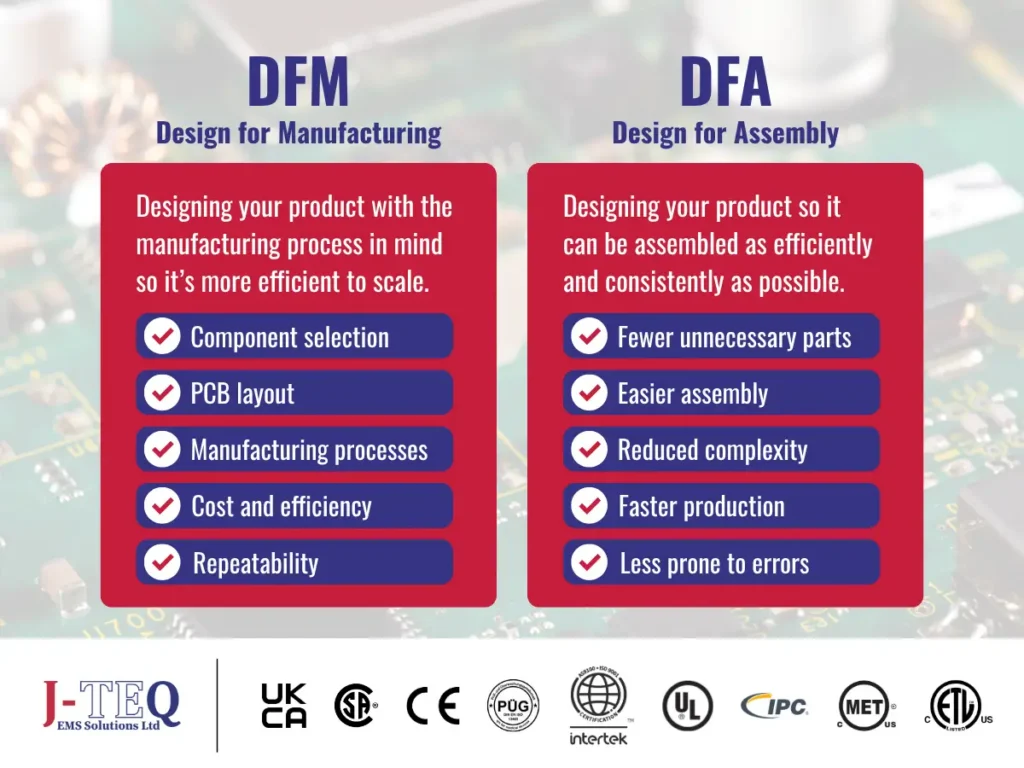
Although they focus on different areas, DfM and DfA often work together rather than in isolation.
PCB assembly is a good example of how the two come together in practice. A PCB designer needs to consider the electrical performance of the board, while manufacturing and assembly requirements determine how effectively that design can move into production. Several factors can affect how successfully components are placed and soldered, including:
Assembly considerations such as component orientation, accessibility, and placement can also affect how efficiently and consistently the board moves through production.
We have previously highlighted this relationship when discussing BGA head-in-pillow defects. Pad design, surface finish, solder mask, and track layout can all affect solder-joint formation. This shows how seemingly small design decisions influence manufacturing quality and create issues that later need to be identified through quality control.
Bringing design, manufacturing, and assembly considerations together early gives engineers more opportunity to identify and address these challenges before production volumes increase.
Modern electronic products have grown incredibly complex, with hundreds or even thousands of individual components. Due to this complexity, even the smallest design decisions can have a big impact once production starts. DfM and DfA create an opportunity to consider those consequences earlier in the design process.
If an issue is spotted and dealt with during the design or prototyping stage, it is much better than after full production has started. Research into engineering change management reports that the cost of making a change can increase by a factor of five to ten as a product moves from early design into manufacturing.
DfM and DfA help identify potential manufacturing issues and assembly challenges while the design is still flexible. Problems ranging from difficult component placement to unnecessarily tight tolerances or awkward assembly steps are easier to address before full production begins.
Rapid prototyping supports this process by allowing engineers to validate design decisions in a real manufacturing environment and identify assembly constraints that may be less obvious on screen. Finding these problems early gives engineering teams more opportunity to refine the design before committing to larger production volumes.
Getting one product to work is one thing, but reproducing that result consistently across hundreds or thousands of units is a much bigger challenge. As production scales, repeatability becomes increasingly important.
Effective DfM reduces production variation by creating designs that align with available equipment and established manufacturing methods. DfA supports the assembly side by removing unnecessary complexity from assembly operations and reducing the risk of incorrect installation. Greater consistency across both areas can contribute to enhanced product quality, particularly as production scales.
When designs become complicated, inefficiencies can easily creep in. Extra components, unusual raw material requirements, and excessive manual processes can all increase production costs without necessarily improving the finished product.
By simplifying and optimising where possible, DfM and DfA can help significantly reduce production costs without compromising performance, product reliability, or overall quality. That might mean fewer parts, a more efficient design, simpler assembly steps, or materials that are easier to source and work with.
The same principles sit at the heart of value engineering, where component substitutions, alternative materials, or revised assembly methods can help improve overall product value and keep production at a low cost per unit.
At higher production volumes, small inefficiencies become much more significant. An extra assembly step, difficult component placement, or unnecessary manual intervention may have little impact during a small production run but become costly when repeated across thousands of units.
DfM and DfA help remove these inefficiencies before higher-volume production begins, making it easier to maintain consistent output as demand increases.
A well-designed product needs to perform as intended, but it also needs to be practical to manufacture and assemble at scale. DfM and DfA help make that possible by identifying issues early and creating a smoother route from design to repeatable production.
At J-TEQ, we work with customers from early design decisions through to production to ensure products are practical to manufacture, straightforward to assemble, and ready to scale.
Planning a new product or preparing to scale production? Speak to us about your next electronics manufacturing project.